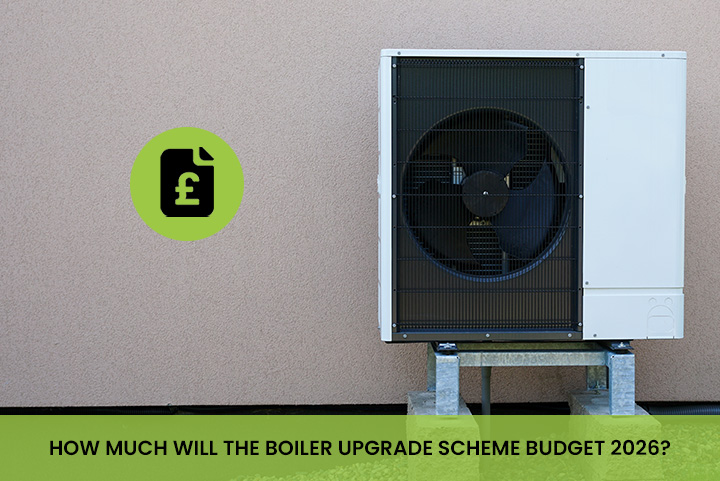
The funds are available. For the 2025/2026 financial year, the UK government has allocated £295 million to the Boiler Upgrade Scheme. This is sufficient to support the installation of between 30,000 and 40,000 units in England and Wales alone.
If you have been holding back on upgrading your heat pump system, then the current budget conditions are as good as they are ever going to be. This is what the budget really means to you.
What the 2026 BUS Budget Covers — And How Much You Can Claim
| System Type | Grant Amount | Typical Install Cost | Typical Out-of-Pocket |
| Air Source Heat Pump (ASHP) | £7,500 | £10,000–£15,000 | £2,500–£7,500 |
| Ground/Water Source Heat Pump | £7,500 | £15,000–£25,000 | £7,500–£17,500 |
| Biomass Boiler | £5,000 | £10,000–£20,000 | £5,000–£15,000 |
How Does the 2026 Scheme Compare to the 2022 Launch?
The scheme has improved significantly since it launched. If you looked at BUS a couple of years ago and decided against it, the numbers have changed in your favour.| Feature | 2022 Launch | 2026 Version |
| ASHP Grant | £5,000 | £7,500 |
| GSHP Grant | £6,000 | £7,500 |
| Biomass Boiler | £5,000 | £5,000 |
| Insulation Rules | Strict mandatory requirements | Flexible — no minimum |
| EPC Requirement | Mandatory | Valid within 10 years |
| Installer Standards | Emerging | MCS certification mandatory |

Switch To A Most Efficient Heating System
Why burn fossil fuels when the air outside can heat your whole home efficiently? Government grants of up to £9,000 make switching to an Air Source Heat Pump easier than ever.
Who Can Actually Claim — Eligibility Explained Plainly
Eligibility isn’t complicated, but the details matter. Getting this wrong wastes everyone’s time. The BUS targets private homeowners in England and Wales replacing fossil fuel heating — gas, oil, LPG, or coal — with a low-carbon alternative.
Core requirements at a glance:
- You own the property — homeowners, landlords, and second home owners all qualify
- You’re replacing a fossil fuel system, not supplementing it
- Your EPC is valid and was issued within the last ten years
- Your chosen system is installed by an MCS-certified professional
Social housing is excluded. New builds are excluded — with the narrow exception of self-builds. Properties that have already received BUS funding in a prior round can reapply with an updated EPC, provided they’re installing a different eligible system.
What If Your Home Has Poor Insulation?
You can still apply. The old rule requiring loft and cavity wall insulation was scrapped in May 2024. Your installer may still recommend insulation improvements — and they’d be right to, since a poorly insulated home reduces heat pump efficiency and increases your running costs. But it’s no longer a condition of eligibility.
How the Application Process Actually Works
The BUS application process is installer-led by design. You don’t submit paperwork to Ofgem directly — your MCS-certified installer does it on your behalf. That keeps the admin burden off homeowners, but it also means your choice of installer directly affects how smoothly the process runs.
Here’s the sequence:
- Find an MCS-certified installer via the official BUS portal or the MCS directory
- Installer assesses your property’s suitability — heat loss, outdoor unit space, electrical supply
- Installer submits the voucher application to Ofgem on your behalf
- You receive a consent confirmation email from Ofgem — respond within 14 days or the application lapses
- Installation completes within 120 days of grant approval
- Installer claims reimbursement directly from government — grant is deducted from your quote upfront
The 120-day window is firm. If your installer misses it, you’ll need to reapply. Choose an installer with a clear installation timeline before you commit.
When Should You Apply to Avoid Missing Out?
Early in the financial year. The £295 million budget is substantial, but demand peaks post-winter as homeowners assess heating bills and plan upgrades. No mid-year exhaustion has been reported for 2025/2026, but that’s not a guarantee. Apply as soon as your installer confirms suitability — there’s no advantage to waiting.
Costs, Savings, and the Real Payback Timeline
The grant reduces your upfront cost. But what does the long-term picture actually look like? That depends heavily on what you’re replacing and your home’s heat demand.
For oil and LPG replacements — typically rural properties — the savings are most dramatic. An ASHP replacing an oil boiler can reduce annual heating bills by £200–£400, with a payback period of five to eight years at current tariffs. Factor in rising fossil fuel prices and that timeline shortens further.
For gas boiler replacements, the comparison is tighter. Running costs for heat pumps versus gas depend on your COP (typically 3–4 for a well-installed ASHP), your electricity tariff, and your insulation standard. Optimised systems on off-peak tariffs reach near-parity or better. Unoptimised systems in poorly insulated homes may cost more to run.
Pairing your heat pump with rooftop solar improves the economics considerably — self-generated electricity drops your effective running cost per unit significantly. The Smart Export Guarantee also allows you to sell surplus generation back to the grid.
Regional and Complementary Funding Options
BUS applies to England and Wales only. Scotland has Home Energy Scotland Grants; Northern Ireland operates separate schemes. If you’re outside England and Wales, check your devolved authority’s current offer before assuming BUS applies.
For low-income households, ECO4 runs parallel to BUS and covers a broader range of energy efficiency measures — including insulation and heating upgrades — at no cost via energy suppliers. BUS and ECO4 cannot be stacked on the same installation, but they can apply to different elements of a wider home improvement project.
The Great British Insulation Scheme and local authority flex funds are also worth checking. Better insulation improves your heat pump’s performance and lowers your running costs — addressing this separately from BUS can make the overall upgrade more cost-effective.
FAQs
The full £295 million covers the 2025/2026 financial year with no reported exhaustion. Check Ofgem’s live dashboard for real-time voucher availability before applying.
Yes. Insulation is no longer a condition of BUS eligibility. Your installer may still recommend it for efficiency reasons, and a valid EPC within the last ten years remains required.
£7,500 for air source, ground source, or water source heat pumps. Biomass boilers receive £5,000. Neither grant covers the full installation cost in most cases.
Installers must complete within 120 days of voucher approval. Most straightforward installations are completed within four to twelve weeks from initial application.
Yes, with a £5,000 grant available. They suit rural properties with reliable access to wood fuel. That said, heat pumps are the government’s clear priority technology for scaling toward net-zero, and biomass carries ongoing fuel cost exposure.
The Boiler Upgrade Scheme offers £9,000 towards an air source heat pump if you’re switching from oil or LPG heating. Most other eligible households, such as those on mains gas, can claim £7,500 towards a heat pump instead.
The Boiler Upgrade Scheme is due to run until 31 March 2028, though it has been extended before and may be extended again. The higher £9,000 grant for oil and LPG homes is temporary and ends on 31 March 2027.
You can qualify for the Boiler Upgrade Scheme if you own a home or small business property in England or Wales. You must be replacing an existing fossil fuel or electric heating system with a low-carbon option, such as a heat pump.
No, currently solar panels are not covered, under BUS grants. However, it is possible that the UK government may offer grants for solar panels, perhaps under warm home plans.