More British households are installing solar panels to save money on their energy bills by reducing reliance on the national grid. In case you are thinking about solar panels installation cost and using this energy-saving method, the process involved is much simpler than many think; however, understanding what is done at each step makes you pose the right questions.
Below is the entire process involved in installing solar panels.
What Happens During Solar Panel Installation
Evaluation of Property and Roof
An installer will begin the process by evaluating your property and the roof itself – which includes its angle and whether there are any trees, chimneys or other structures near the house that could provide shade over the course of the day. Roofs that face south produce the most energy, however those facing east and west can also be used effectively for solar installations.
The surveyor will ensure that the additional load is safe for your roof construction to take, as well as making sure that your consumer unit and cabling can cope with the new installation. Many contractors also use satellites or 3D modelling software during site visits, taking into account how much sun is available at different times of the year.
System Design and Choice of Panels
Based on the findings from the survey, the installer will design a system that is designed for the available roof space and your household’s electrical usage. The majority of residential installations in the UK usually range between 3kWp to 5kWp, but sometimes, if it is a large family home with very high daytime energy usage, more capacity may be required. You will also choose your solar panels at this stage. Monocrystalline panels are typically the popular choice when it comes to solar PV installation for homes.
Solar Inverter and Battery Installation
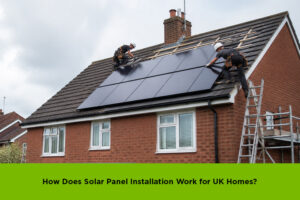
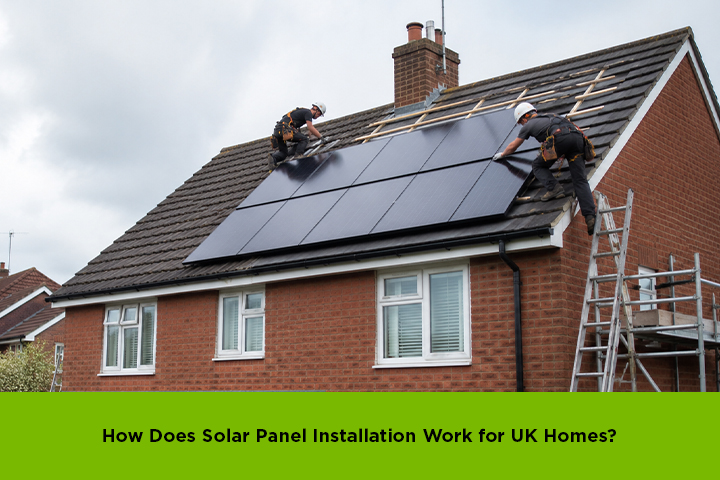
On the day of installation, the solar panels are attached to rails that have been placed on your roof, then hooked up to the inverter, where the DC current that the panels generate is converted to AC current that is used in your home. If you are installing a battery, this will be installed in a garage, utility space, or shed and wired in so that it stores any excess energy produced during the day for use at night.
Commissioning and Ongoing Performance
Once everything is connected, the installer tests the system, registers it with your network operator, and issues the certification you’ll need to claim payments for any electricity you export. From there, performance is mostly hands-off. The use of an app or display makes it possible for you to monitor energy generation in real time, and apart from the maintenance that requires cleaning at regular intervals and occasionally checking the system, there is not much you have to do.
Warranties for panels run up to 20-25 years, and usually you would have to change the inverters only once during the course of 10-15 years. Monitoring systems are able to detect any significant decline in output by themselves.
Switch to Renewable Energy, Start Big Savings
Sunshine is free. Your energy bill shouldn’t be. A solar PV system built for British weather could cut your annual costs by up to £1,080.
Factors to Weigh Before You Install
A few decisions early on shape how much value you get from the system for years to come:
- Roof suitability: orientation, pitch, shading, and structural condition all affect output and cost.
- System size: bigger isn’t automatically better; the right size matches your roof space to your actual usage.
- Electricity consumption: a household that’s home and using power during the day gets more value from solar than one that’s out at work, unless it’s paired with storage.
- Panel positioning: even small shading issues, like a chimney shadow at certain times of year, can meaningfully cut output.
- Battery storage: storage lets you use more of what you generate instead of exporting it at a lower rate than you pay to import.
- Expected energy generation: a good installer gives you a realistic estimate based on your specific roof, not a generic figure.
The Benefits of Solar Energy for UK Homes
The most immediate of the solar panel benefits is lower electricity bills: every unit of solar energy you generate and use is one you don’t have to buy from your supplier. Over time, that adds up to real energy savings, particularly with electricity prices staying high.
Beyond the bill saving, solar gives you a degree of energy independence. You’re generating your own power rather than relying entirely on the grid, and if you add battery storage, you can keep using that power well after the sun goes down. This reduced reliance on grid electricity is a big part of why homeowners now see solar power for homes as a practical long-term investment rather than a lifestyle choice.
There’s also an income side worth knowing about. Through the Smart Export Guarantee, licensed suppliers pay you for any surplus electricity your system exports to the grid. Rates vary considerably between suppliers, from just a few pence up to around 30p per kilowatt-hour on the best tariffs, so it’s worth comparing options once your system is registered. It won’t cover your costs on its own, but it’s a genuine bonus on top of what you already save by using your own renewable energy at home.
Why Choose Professional Solar Panel Installation Services
None of these benefits are guaranteed by the equipment alone. A poorly positioned panel, an undersized inverter, or a badly sealed roof mount can quietly undercut your system’s output for years, and can get in the way of claiming export payments at all, since registration requires a certified installation. Working with an experienced solar panel installer protects you on both counts: proper installation keeps your roof watertight and your electrics safe, and correct system design means you actually get the output you were quoted.
Incorrect roof penetrations can also void your existing roof warranty, which is one more reason this isn’t a job worth shopping on price alone. Professional solar panel installation services also typically include workmanship warranties on top of the manufacturer’s product warranty, so if something does go wrong, you’re not the one covering the cost. For a job that sits on your roof and powers your home for the next 25 years, that reliability is worth paying for.
If you’re ready to explore what a renewable energy system could look like for your property, a proper site assessment is the best place to start.
Related guides
Frequently Asked Questions
Most residential installations are completed in one to three days, depending on system size and whether you’re adding battery storage. The property assessment and system design happen beforehand, so installation day itself is mainly mounting, wiring, and testing.
Generally speaking, most properties can fit solar panels on their roofs as part of their permitted development rights and without the need to obtain planning permission. Listed buildings, conservation areas, and some flats are notable exceptions to this general rule.
Yes. Solar panels facing east and west produce about 20% less energy than the ones facing south, but they are still cost-effective and may even be better for people who consume more electricity in the morning and at night.
It varies on the size of your system, the state of your roof, and the proportion of your consumption that occurs during daylight, but most people end up saving, particularly if they have batteries enabling them to utilize more of the power they produce.
The SEG entails paying people for exporting excess power produced by their solar systems to the national grid. After installation and accreditation, one can sign up with any accredited supplier, irrespective of their being from the same company as your current electricity supplier.
For an average 2-3 bedroom sized UK home, 10-14 solar panels or 3.5 – 4 kW solar system is sufficient to keep the home glow even at night. However, the exact number & power may vary depending on energy consumption and local climatic conditions.
On average, solar panels can last for up to 25 years. However, some high-quality models can function for up to 30 years, even more if maintained properly. Basically, solar panels do not stop working suddenly after the average lifespan; they just lose approximately 0.2%-0.5% of efficiency each year.
Yes, solar panels can generate electricity even on cloudy days, but make much less energy than in bright sunshine. Modern (all-black) panels just need daylight to transform into DC current. Output is about 60% to 80% in light clouds and 10% to 40% in heavy clouds.
Solar panels need only too little maintenance, especially if they are installed with bird-proofing. Usually, rain washes away most dust on tilted roofs, so only a gentle clean with pure water and a soft brush is sufficient once a year to clean if dirt, bird mess or lichen builds up.
Yes, solar panels always work even if it’s winter. They make power from the light hitting the panels, not from the warmth. Even so, the output drops. In many places it can be only about 20% to 30% of what you get in summer. This happens because the days are shorter, the sun is lower in the sky, and cloud cover shows up more often.
Yes, solar panels always work even if it’s winter. They make power from the light hitting the panels, not from the warmth. Even so, the output drops. In many places it can be only about 20% to 30% of what you get in summer. This happens because the days are shorter, the sun is lower in the sky, and cloud cover shows up more often.