The vast majority of people applying for the Boiler Upgrade Scheme (BUS) have already been misled long before they click the first link. They search for “boiler upgrade grant UK” expecting a rebate on a new shiny gas boiler costing £7,500. They are excited. Then they click on the eligibility page to find out that the scheme doesn’t touch a gas boiler. Not a condensing one, not an A-rated one, not even the most efficient models available today.
BUS is a decarbonisation programme, not a heating maintenance fund. The UK government pays you to walk away from fossil fuels. If you’re not ready to do that, ECO4 is the route to take, not this one. If you get that wrong, you will waste weeks, even months, on an application that was never going to work.
What the Boiler Upgrade Scheme Actually Does?
BUS replaced the Renewable Heat Incentive in 2022. Where RHI paid quarterly for a period of seven years, BUS pays upfront as a grant applied directly to the installation costs. You never see the money, your MCS-certified installer deducts it from your invoice and claims it back from Ofgem. You pay the rest.
The grant amounts as of 2026:
| Replacement System | Grant Value |
| Air Source Heat Pump | £7,500 |
| Ground Source Heat Pump | £7,500 |
| Biomass Boiler | £5,000 |
The scheme is run out of England and Wales only. Home Energy Scotland operates in Scotland, while Northern Ireland has its own devolved funding. If you’re reading this in Edinburgh or Belfast, then BUS isn’t for you!
Which Existing Heating Systems Qualify?
There is one screening question: What fuel do you use with your current system? If it is fossil fuel or electric, you can replace it. If you have already replaced it with a heat pump, you can’t.
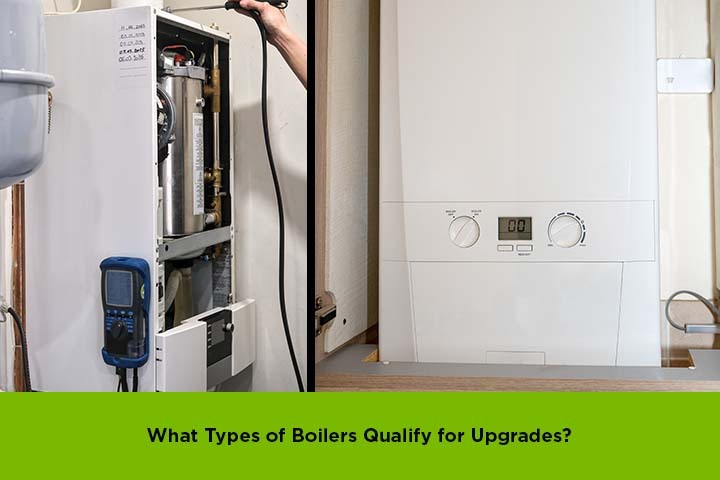
Existing System Qualifies for BUS? Gas combi boiler Yes Gas system boiler Yes Conventional (regular) gas boiler Yes Oil boiler Yes LPG boiler Yes Propane heating system Yes Back boiler (gas or oil) Yes Electric storage heaters Yes Direct electric panel heaters Yes Existing air source heat pump No Existing ground source heat pump No Biomass replacing biomass Usually No
Can I Replace a Gas Boiler With a Heat Pump?
Yes, and this is exactly what BUS is designed to support. In the UK, gas heating contributes about 14% of carbon emissions. Replacing a gas boiler with a heat pump through BUS will give homeowners the biggest possible boost to household decarbonisation.

Switch To A Most Efficient Heating System
Why burn fossil fuels when the air outside can heat your whole home efficiently? Government grants of up to £9,000 make switching to an Air Source Heat Pump easier than ever.
The Three Qualifying Replacement Systems
Air Source Heat Pumps
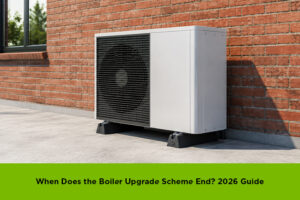
An air source heat pump (ASHP) extracts thermal energy from outdoor air, compresses it through a refrigerant cycle, and transfers heat into your home via a heat exchanger. It works on the same principle as a refrigerator, just running in reverse. Even when outdoor temperatures drop to -15°C, modern units still produce usable heat, though efficiency falls as ambient temperature drops.
Efficiency is measured by the Coefficient of Performance (COP). Heat pumps with a COP of 3.0 produce 3kW of heat per 1kW of electricity consumed. Gas boilers, even high-efficiency condensing models, run at 80–94% efficiency (0.8–0.94 kW of heat per kW of fuel). The heat pump always wins in physics, since it doesn’t generate heat; it moves it.
Running Costs Vs Gas
At current electricity and gas tariffs in 2026, heat pump operating costs per kWh of heat delivered are typically lower than that of gas when considering COP. For a well-insulated home, your annual space heating bill drops 20–40% after switching from gas. For a poorly insulated home, the savings are smaller or disappear altogether, which is why it’s crucial to do a heat loss assessment prior to installing a heat pump.
Ground Source Heat Pumps
Ground source heat pumps (GSHPs) are also known as geothermal heat pumps, although geothermal heat pumps rely on the deep geological heat. GSHPs use the earth’s near-surface temperature, which remains stable all year round at around 8–12°C in the UK.
You should have either:
- Horizontal ground loops: buried in trenches 1–2 metres deep, requiring significant garden space
- Vertical boreholes: dug 50–200 m down, require far less surface area.
GSHPs can achieve higher COPs than their air source counterparts (COP 3.5–5.0 vs 2.5–4.0 for air source). But it has the negative cost of ground loops or boreholes (£5,000–£15,000 extra work) which is partly offset by the £7,500 grant.
Biomass Boilers
Biomass has the smallest grant (£5,000) because it is the least scalable. In principle, it is still combustion, burning pellets, chips or logs. This involves particulates, fire risk and storage of fuel. It is low-carbon rather than zero-carbon as wood grown sustainably offsets its own emissions over its growth cycle.
In rural areas where it’s not cost effective to install a heat pump (the property is off the gas grid and far enough away that an air source heat pump will never be able to meet the heat demand at current cost), BUS has restricted biomass to farms.
For the vast majority of homeowners in the UK, the topic is heat pumps.
How the Heating System Actually Works
If you’re spending £10,000–£25,000 replacing your heating, you should know what you’re installing. This section explains the HVAC mechanics without the jargon.
How Heat Exchangers and Coils Transfer Energy
Heat pumps consist of two heat exchangers: an evaporator and a condenser. In the air source unit, the evaporator coil sits in the outdoor unit. Refrigerant flows through the coils at very low pressure and evaporates at low temperatures, taking heat from the outside air.
The refrigerant vapour is then compressed (the temperature of the refrigerant increases significantly), and passed through the indoor condenser coil, where it releases heat into your heating circuit water. The refrigerant condenses back to liquid, and the cycle repeats itself.
Will a Heat Pump Work in an Uninsulated Home?
Heat loss is a key factor. Now think of a Victorian semi with single-glazed windows and no loft insulation, whose solid walls are uninsulated.
BUS updated in 2026. You are also no longer required to prepare for a loft or cavity wall insulation check as part of your entitlement. That doesn’t change the fundamentals, though.
What is “best heating system for insulated homes”?
And in a fully insulated EPC C or above home with loft insulation, double glazing and heat pump installed, gas will always be more expensive to run subject to the COP. If your home is EPC E–G, it’s not so clear-cut and it might help to put insulation in either before or afterwards – you could always read more up on this here
How Your Bills Are Affected by Energy Efficiency
Outdated numbers often mix up the heat pump vs gas boiler argument. This is a grounded breakdown using current tariff structures in the UK (2026).
| Metric | Gas Boiler | Air Source Heat Pump |
| Efficiency | 85–94% (condensing) | 250–400% (COP 2.5–4.0) |
| Fuel cost per unit | ~7p/kWh (gas) | ~24p/kWh (electricity) |
| Effective cost per kWh of heat | ~8p | ~7–10p (varies with COP) |
| Carbon per kWh of heat | ~0.18 kg CO₂ | ~0.04–0.07 kg CO₂ |
| Typical annual space heating bill (3-bed semi) | £900–£1,200 | £700–£1,100 |
Central to these assumptions is the electricity-to-gas price ratio observed during periods such as 2021–2023. A heat pump with a COP of 3 becomes highly competitive when electricity costs are around three times higher than gas. Heat pumps are expected to become cheaper to run than gas as the grid decarbonises and gas prices rise. Smart tariffs, such as those offered by Octopus Agile and Intelligent Octopus, can offer significant running cost savings by charging the heat pump during low overnight electricity rates.
Property Eligibility Rules
Leaving aside, “What fuel does your current system consume?”, BUS specifies the conditions on the property level:
You must own the property.
The grant is assigned to the property owner so even tenants can’t apply (not even with permission). Rental Owners Can Apply on behalf of Houses There are separate commercial reasons for this.
England or Wales. The property has to be located in England or Wales.
Such systems will be inflexible – funding arrangements will vary in Scotland and Northern Ireland.
The capacity of the replacement system should not be more than 45kW.
This procurement can possibly include nearly every home and in the case of commercial and mixed-use buildings, it may easily be an entirely different process.
You cannot combine with ECO4 ever, at the same property at the same time.
As long as you have ECO4 installed, you cannot access BUS for the same address.
BUS vs ECO4: Stop Mixing Two Distinct Schemes
Both schemes are often confused because they involve home heating and public funding, but they serve very different purposes and support different technologies.
| Feature | Boiler Upgrade Scheme | ECO4 |
| What it funds | Heat pump or biomass | High-efficiency gas boiler |
| Income test | None | Benefits or income under ~£31k |
| EPC requirement | None | EPC E–G |
| Who can apply | Homeowners only | Homeowners and tenants |
| Location | England and Wales | Great Britain |
| Grant value | Up to £7,500 | Fully funded if eligible |
| Target outcome | Decarbonisation | Fuel poverty relief |
| Technology goal | Remove fossil fuels | Improve fossil fuel efficiency |
In most cases, the difference is straightforward. If you are on Universal Credit, have a broken gas boiler, and your property has an EPC rating of F, you are more likely to qualify for ECO4. If you are a homeowner above the ECO4 income threshold and want to reduce carbon emissions while potentially lowering long-term heating costs, the Boiler Upgrade Scheme is usually the better fit.
How the Application Process Works
You do not directly apply to BUS. Specifically, this is why the scheme purposefully routes everything through MCS-certified installers, to secure compliance before funding and technical competencies before installation.
Step 1: Find MCS certified installer.
MCS (Microgeneration Certification Scheme) is the quality standard for installers of renewable energy technology in the UK. Certifications can be verified at mcscertified. com. You must not have an unapproved installer; a grant for an installation that doesn’t have MCS accreditation will not be made available.
Step 2: Obtain a Heat Loss Calculation
A good installer will perform a comprehensive heat loss calculation on your property. It decides the system size, whether radiators need upgrading and helps confirm that the installation will actually work.
Step 3: Get a quote with the, grant taken off.
The £7,500 (or £5,000 for biomass) is deducted from this total. You pay the balance upon completion.
Step 4: The installer applies on your behalf.
They only apply for, and are paid by Ofgem for the grant after installation You don’t handle this.
Step 5: Retain all documentation.
MCS Certificate to prove the design and installation of your system, building regulations approval and warranties for products. For these concerns, for later property sales and for any tariff claims afterwards.
The Bottom Line
BUS has a big heart, but also frugal. The new scheme, has already been revealed – it won’t replace a gas boiler, won’t fund insulation and won’t pay a single penny to anybody who has low-carbon heating in place.
What it will do is discount £7,500 from the cost of replacing a fossil fuel system such as gas heating or oil heating with a full-systems heat pump swap-out, a level of reduction big enough to make the economics of switching in many cases pretty persuasive for homeowners.
If you are having a gas/oil/LPG/propane-fired or direct electric heating system, you qualify – get an MCS-compliant installer out to your property, do the heat loss calculation and give a quote with the grant deducted. The first use of that conversation is free and gives you all of the information.
FAQs
No. A perfectly functioning gas boiler may well qualify. BOOKS do not care about the condition; they care about the availability of fuel type. But your installer does not ask whether it still works.