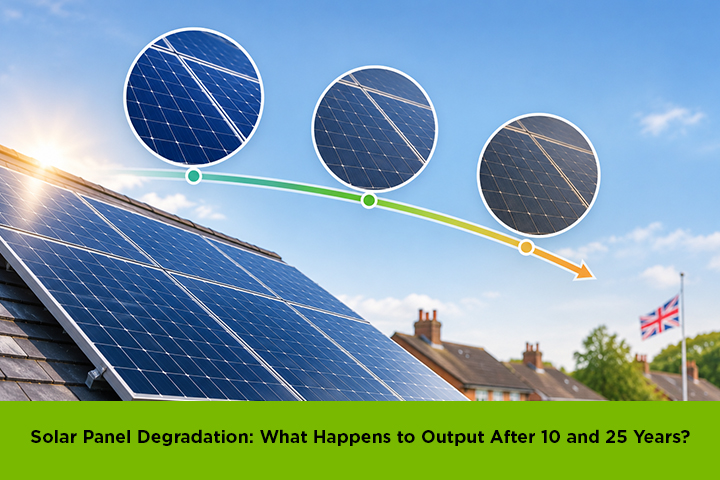
Every year solar panels lose some efficiency. This phenomenon of gradually fading over time is known as solar panel degradation. But with modern panels, the electricity can be generated for 25-30 years or even more!
Most modern solar panels still have a 90% to 95% efficiency after 10 years. They generally maintain a 80% – 90% retention rate after 25 years. These numbers are influenced by panel quality, installation and environmental conditions.
The good news is that UK climate conditions will minimize the effects of high temperatures on your solar panels. With proper installation and maintenance, solar panels can operate for decades providing reliable power supply. Understanding the types of degradation will help you to choose more efficient solar panels and plan long-term benefits.
What Is Solar Panel Degradation?
The degradation of solar panels refers to a decrease in electric generation over time. It occurs with the exposure to sunlight, weather and heat on panel materials. This is expected and is NOT an indication of defective panels. But quick degradation may decrease your long-term energy savings.
Degradation is measured by the manufacturers annually by performance testing. They also offer warranties on predicted power delivery over the years.
Solar Panel Efficiency After 10 Years and 25 Years
Over time the output of solar panels diminishes because of the deterioration of their materials. Loss is typically a small amount per year but it adds up over time.
How Much Do Solar Panels Degrade Over 10 Years?
Modern solar panels degrade about 0.3% – 0.5% per year. Other models have greater loss rates, particularly in the first year. Many panels still produce ~95 percent of their initial output after 10 years.
Some might hold on to as much as 90% depending on the quality. For instance, after 10 years a 400W solar panel could generate approximately 380W. This assumes that the total reduction is 5% if the testing conditions are similar.
Solar Panel Efficiency After 25 Years
The typical good solar panel will keep generating power for much longer than its typical 25-year warranty. They can produce depending on their original quality and degradation rate. Many panels have about 85% to 90% of their initial output after 25 years. There are manufacturers that specify minimum production at 80% or as high as 85%.
For instance, if the 400W panel is able to retain 85% output, it can provide around 340W. This number is based on standard test conditions and is an equivalent output. Other factors that affect electricity generation in the real world are the amount of shading, the temperature, and the angle at which the electricity-generating panels are oriented.
What Is the Solar Panel Output After 30 Years?
Solar panels don’t suddenly go out of order after 25 years. A large number of systems are still producing power for another 10 years. If the annual rate of panel degradation is 0.4%, the panel will have 88% of its original value after 30 years. But, actually there are differences in performance across manufacturer and installation.
It can help to detect issues before they impact generation by conducting regular inspections. Hence, the panels can be replaced automatically only after 25 years, which is infrequent.
Switch to Renewable Energy, Start Big Savings
Sunshine is free. Your energy bill shouldn’t be. A solar PV system built for British weather could cut your annual costs by up to £1,080.
What Is a Good Solar Panel Degradation Rate Per Year UK?
Generally, a degradation rate of less than 0.5% per year is considered good. Higher quality panels can provide even smaller anticipated rates. The expectations are supported by the research of the National Renewable Energy Laboratory (NREL). Annual losses of 0.4% to 0.5% have been detected in the monitored panels. Others even better panels are offered by some manufacturers.
These figures are helpful for UK homeowners to compare solar panels. But be sure to always verify the manufacturer’s true performance warranty.
N-Type vs P-Type Solar Panel Degradation
The panels used to capture the sun’s energy are of varying cell technologies. Their designs may impact long term performance and degradation.
P-Type solar panels:
- Older PERC technology is often used for these panels.
- They may suffer from light induced degradation at early stage of operation.
- Some of them are more prone to performance loss due to heat.
N-Type solar panels:
- They are, for instance, modern TOPCon and HJT technologies.
- They show good resistance to some degradation mechanisms in general.
- The quality of manufacturing and the materials used determines their performance.
N-Type technology is not automatically more reliable in every situation. Independent testing has identified weaknesses in some N-Type products.
Kiwa PVEL’s 2025 testing found differences in UV-related degradation. Some tested N-Type modules showed greater sensitivity than P-Type modules.
N-Type TOPCon and HJT Degradation Rates in 2026
Currently, the TOPCon and HJT are widely used in the construction of new PV systems. Both technologies are trying to achieve efficiency gains and minimise energy losses. There are differences in their degradation rates, however, depending on manufacturer. The long term results are also influenced by testing conditions and panel materials.
Avoid selecting panels because of the technology’s name. Compare the independent test results against each other, annual degradation rates and warranty conditions.
Solar Panel Output and Efficiency Comparison After 5, 10, 20, 25 and 30 Years
Solar panels of various technology types age at varying rates. The quality of the panels, cells, and production process also play roles in performance over time.
The following comparison is based on the output degradation of a 400 Watt Solar Panel over time.
It is assumed that the power loss in this scenario happens at a constant rate each year after being put into service.
Solar Panel Efficiency and Output Comparison
| Solar panel type | Annual degradation (assumed) | After 5 years | After 10 years | After 20 years | After 25 years | After 30 years |
| N-Type TOPCon | 0.4% | 392W | 384W | 369W | 362W | 355W |
| N-Type HJT | 0.35% | 393W | 386W | 373W | 366W | 360W |
| P-Type PERC | 0.5% | 390W | 380W | 362W | 353W | 344W |
| Polycrystalline | 0.6% | 388W | 376W | 354W | 344W | 334W |
| Thin-Film | 0.7% | 386W | 373W | 347W | 335W | 324W |
What Does This Comparison Tell You?
- N-Type HJT: Offers strong long-term performance in this example.
- N-Type TOPCon: Maintains high output with relatively low degradation.
- P-Type PERC: Provides reliable performance with slightly higher assumed degradation.
- Polycrystalline: Generally experiences higher degradation than modern N-Type options.
- Thin-Film: Performance varies significantly between different thin-film technologies.
Important: These rates are comparison assumptions, not universal industry averages. Some modern thin-film products perform differently, while individual PERC and N-Type panels can outperform these estimates.
What Causes Solar Panel Degradation?
There are multiple natural and environmental factors that have a gradual impact on solar panel performance. Knowing these things can help home owners preserve their investment.
1. Light-Induced Degradation (LID)
This type of degradation occurs immediately after solar panels receive the first sun rays. It can cause an early reduction in electricity output. This effect is usually more noticeable during initial operation. Modern panel designs have reduced this problem considerably.
2. Heat and Temperature Changes
Increased temperature increases electrical resistance in solar cells. Frequent temperature changes can cause mechanical stress on the material of solar panels. UK climate conditions provide less heat stress than tropical regions, however, seasonal temperature changes influence some elements of solar panels.
3. Microcracks and Thermal Defects
Microcracks are cracks in solar cells which occur during transportation, installation or operation of the panels. Temperature changes can increase stress on the panels, as well as mechanical shock from wind or impact.
Some microcracks do not affect the operation of panels, others decrease their power generation capabilities. Professional inspection can reveal critical defects and prevent further damage.
4. Moisture and UV Exposure
Rain, moisture and sunlight cause physical damage to panels’ materials. Damaged seals can allow moisture entering inside the panels causing corrosion, insulation issues or reducing the electrical performance of panels. Proper materials and installation minimize the risks of these types of degradation.
Linear Performance Warranty vs Product Warranty
There are various warranties that cover various aspects of your investment when you install solar panels. Knowing what they are apart from each other will be able to prevent any unanticipated expenses.
Product warranty:
- Covers manufacturing defects and material problems.
- Protects against issues such as faulty connections and damaged components.
- Usually lasts between 12 and 25 years, depending on the manufacturer.
Linear performance warranty:
- Guarantees a minimum electricity output over a stated period.
- Sets limits on acceptable annual degradation.
- Often provides protection for 25 to 30 years.
For example, a 25-year warranty means that after 25 years the PV module will produce 85% of its original power. This implies the panel should be able to do that at the lowest level. Always check both warranties before purchasing your solar panels. In addition, look into claims and exclusions conditions and replacement policies.
Do Solar Inverters Degrade Faster Than Solar Panels?
Yes, solar inverters typically will have a shorter lifespan than solar panels. Most of the current panels have a lifespan of 25-30 years.
But the typical life of string inverters is about 10 to 15 years. The stress placed on their electronic components is periodic, especially with regards to thermal stress.
This could lead to an inverter replacement within the lifetime of the home. The replacement costs vary depending on the type, capacity and installation requirements of the inverter.
The life span and replacement cost of microinverter and hybrid inverter are different. Before selecting a system, make sure to read their individual warranties.
Keep in mind that inverter replacement does not necessarily imply the need for solar panel replacement. Existing panels can be used for generating electricity using suitable equipment.
How Can You Reduce Solar Panel Degradation?
Natural degradation cannot be avoided. But, with proper installation and maintenance, your system can be protected.
Follow these practical steps:
- Choose quality panels: Look at independent test results and manufacturer’s guarantees.
- Use qualified installers: Make sure correct mounting, wiring and electrical connections are made.
- Avoid physical damage: Avoid placing heavy objects on panels and unnecessary pressure.
- Maintain cleanliness: Remove excessive dirt, leaves and bird droppings when necessary.
- Monitor electricity production: Regularly check the monitoring-app on the inverter.
- Arrange inspections: Request from qualified personnel to examine abnormal changes in performance.
Do not climb on the roof for inspection or cleaning. Professional assistance avoids accidents and damages to equipment.
Final Thoughts
Degradation is a natural process occurring during long-term usage of solar panels. Modern panels can generate reliable electric power for decades. High-quality solar panels maintain approximately 90%-95% of its performance after ten years and about 85%-90% performance after 25 years.
Choosing reliable solar panels and installing a company ensures good long-term performance of solar panels. Regular monitoring also ensures long-term efficiency. Invest in quality solar panels to receive reliable energy for many years.
Editorial note: Actual degradation depends on the product and installation. Warranty figures represent minimum performance guarantee.
Protect your panel efficiency with the highest-rated solar panel installation UK experts. Click here for a free efficiency quote!
Frequently Asked Questions
Yes. Solar panels lose efficiency gradually, however, annual loss is minimal in modern solar panels.
Yes. But the power generating capacity will be reduced as the age goes up.
While rain does help to keep solar panels clean, if the seal is damaged or the installation is not done correctly, moisture problems may occur.
No! Only replace panels when necessary as a result of performance, damages or repair cost.
N-Type panels have relatively good degradation characteristics. But quality and independent reliability testing are still significant for manufacturing.